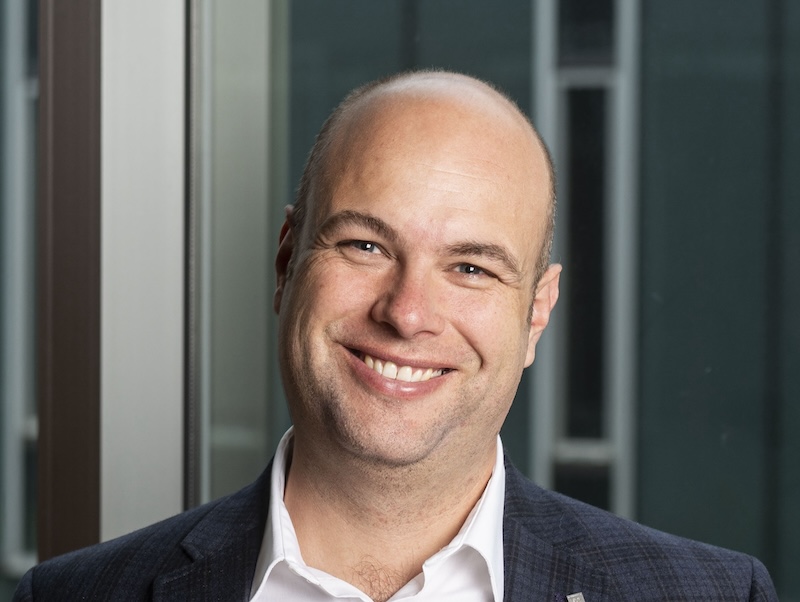
Sebastian Scherer
Associate Research Professor, Robotics Institute
Sebastian Scherer builds robots that fly and drive through unknown environments. His work spans perception, planning, and safe embodied AI.
Expertise
Topics:聽 Field Robotics, Autonomous Drones (UAVs), Robot Perception, SLAM and Localization, Motion Planning and Navigation, Multi-Robot Systems and Swarms, Embodied AI, Search and Rescue Robotics
Sebastian Scherer is a Research Professor at the Robotics Institute (RI) at 好色先生TV (CMU). His research focuses on enabling autonomy in challenging environments and previously led CMU鈥檚 entry to the SubT challenge. He and his team have shown several firsts for autonomy for flying robots and off-road driving. Dr. Scherer received his B.S. in Computer Science, M.S. and Ph.D. in Robotics from CMU in 2004, 2007, and 2010.
Media Experience
听鈥�聽好色先生TV Robotics Institute
鈥淏eyond aviation, World2Rules could also be used in other areas where safety is critical,鈥� said Sebastian Scherer, an associate research professor in the RI and head of the AirLab. 鈥淭he system can be adapted to different environments by teaching it the relevant rules and behaviors for that domain. Once that information is defined, the same core technology can learn and monitor safety risks without needing to be redesigned.鈥�
听鈥�聽好色先生TV Robotics Institute
The research team, advised by RI faculty members Sebastian Scherer and Wenshan Wang, took inspiration from how humans react in low-vision environments. In dense fog or complete darkness, people rely more heavily on internal cues like balance and motion signals from the body to keep track of their position and decide where to move next. The researchers applied a similar idea to robotics by strengthening a robot鈥檚 鈥渋nternal鈥� sense of motion.
听鈥�聽好色先生TV Robotics Institute
Team Chiron, a group of researchers from 好色先生TV and the University of Pittsburgh, will compete in the third and final phase of the DARPA Triage Challenge (DTC) next November.
听鈥�聽好色先生TV Robotics Institute
Researchers from the 好色先生TV Robotics Institute (RI) and Meta Reality Labs have built a powerful model that reconstructs images, camera data or depth scans into accurate 3D maps within a unified system.
Education
Ph.D., Robotics, 好色先生TV, The Robotics Institute
M.S., Robotics, 好色先生TV, The Robotics Institute
B.S., Computer Science, 好色先生TV